The EzyEducation website uses cookies to help ensure we give you the best experience.
If you continue without changing your settings, we assume that you are happy to receive all cookies on the EzyEducation website.
Please refer to our Privacy and Cookies Statement to find out more.

Continue

Economic Terms

Heckscher-Ohlin Model

Is a mathematical trade model that states that countries will specialise in goods that they have a relative factor abundancy in i.e. a country will export products produced using factors of production that they are relatively abundant in and import products where production requires the use of scarce factors.


Hedge Fund

Engage in private investments by trading securities on behalf of their clients by hedging against volatility and instability in financial markets. However as hedge funds have become more prominent so has the perceived risiness with them.


Helicopter Money

When a central bank directly finances a government budget deficit by printing more public money. This is an alternative form of the conventional public policy choice of monetary policy but often is overlooked due to the hyperinflation concerns that arise.


Herding Behaviour

Is a term that applies to a trend often seen in investing, in which all investors tend to mimic each others actions and this causes asset prices to significanty decline or rise. These investors may not always be acting rationally.

Below is a graphic which shows the ramifications of asset prices falling due to herding effects. If asset prices fall this causes investors to lose a large value of their investments. Which ultimately can cause a financial crisis or a recession, as confidence from the financial sector drains away.


Heterogenous goods

Goods where the features of products are heavily differentiated e.g smart phones and cars.

Hit-and-run entry

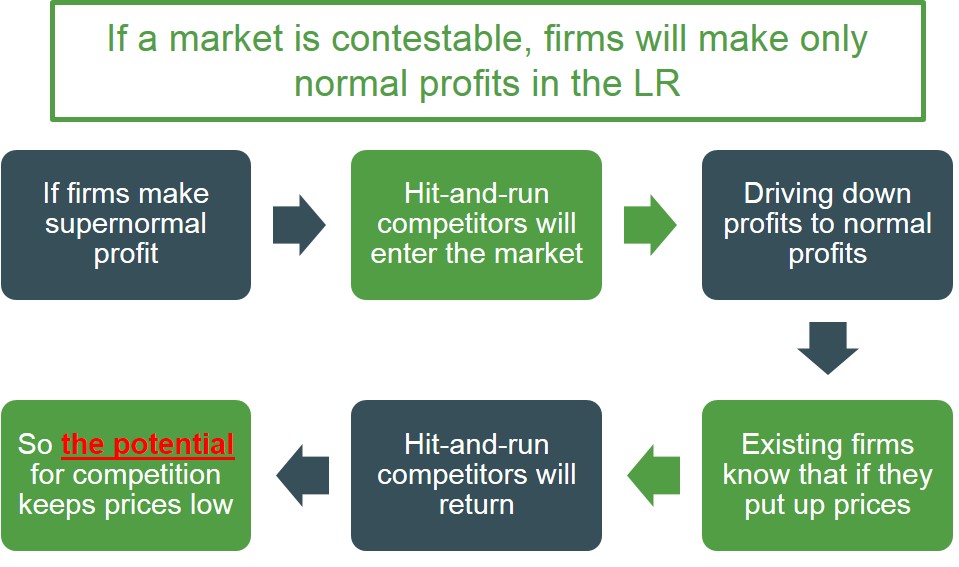
This is a special case of entry that exists in markets that are highly contestable. The lack of sunk costs and the ability to freely enter and exit means that new firms can enter the market and undercut the current incumbent firms to steal the abnormal profit. They can quickly leave the market costlessly before the incumbent has had time to react with a price match. This explains why markets that are classed as contestable, will often see incumbents charging a price close to the marginal cost to prevent being undercut.

Below illustrates the logical sequence of reasoning why incumbent firms keep prices extremely low despite the high degree of market power they have, as they are vulnerable to hit-and-run entry. By keeping prices low the profit rewards and incentives of hit-and-run entry is reduced and incumbent firms feel more secure in their market position. So peversely in these types of market the best way to maximise profits in the long-term is to make small profits in the short-term.



HM Treasury

Is the government department responsible for for formulating and developing public finance and economic policy and controlled by The Chancellor of the Exchequer (currently George Osborne).

HMRC

Her Majesty’s Revenue and Customs. Its main responsibility is the administration and collection of UK taxes.

Homogenous goods

Goods where the features of products are similar e.g gas and water.

If all firms produce exactly the same product there can be no price competition and only non-price competition such as product differentiation and advertising campaigns. This is because buyers have an unlimited option when purchasing this type of good and therefore if all goods are the same, the sole reason for buying a product from a specific firm is solely based on price and if the costs of production are the same undercutting rivals will not steal the market share and sales.


Horizontal Integration

Horizontal integration occurs when there is a merger between two firms in the same industry operating at the same stage of production. For example two firms both producing products in the primary sector merging that would be an example of this type of integration. This enables firms to benefit from economies of scale and build up a more efficient distribution network. A real life example was in 2013 when US Airways merged with American Airlines to benefit from managerial economies of scale to raise efficiency and productivity, as well as increasing the level of market power for the newly merged firm.


Display #