The EzyEducation website uses cookies to help ensure we give you the best experience.
If you continue without changing your settings, we assume that you are happy to receive all cookies on the EzyEducation website.
Please refer to our Privacy and Cookies Statement to find out more.

Continue

Economic Terms

Private goods

A good that is scarce because it is excludable (it is possible to exclude non-consumers from the benefit of a good or service) and rivalrous (the consumption of a good by one consumer diminishes the amount of the good available to other consumers).

Privately optimal output

The equilibrium level of output if external costs/benefits experienced by third parties are not reflected in the market equilibrium.

Privatisation

The process by which a state owned enterprise would be sold to private and institutional investors e.g. Royal Mail.

Producer Sovereignty

The production of goods and services is influenced by the preferences of producers.


Producer surplus

The benefit achieved by suppliers because the equilibrium price is higher than the price suppliers would be prepared to supply the goods at. This is always represented by the area above the supply curve and below the market price.


Producer tax burden

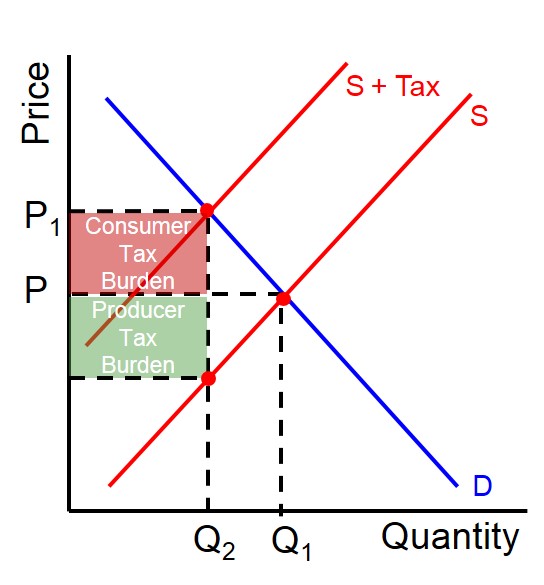
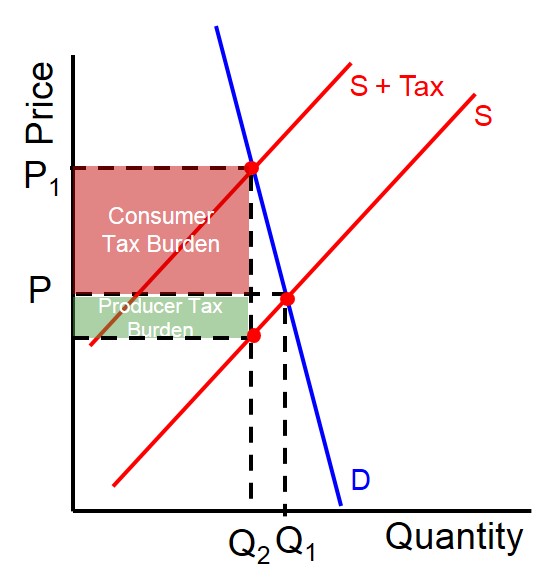
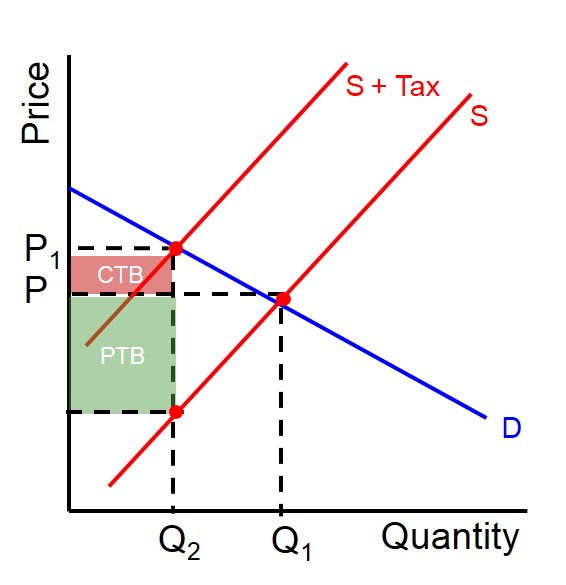
The amount by which the imposition of an indirect tax will reduce producer surplus. The tax burden imposed on producers will depend crucially on the elasticity of the demand curve facing the market. As the less price sensitive consumers are the more of the tax that can be passed onto them in the form of higher prices as it will increase their level of profit despite price rises due to a lack of drop-off in demand.

Below is a diagram to illustrate how the imposition of an indirect tax implaces a burden on producers. In this instance the demand curve is neither inelastic or elastic and therefore the tax burden is split evenly between the consumers and producers.
Below is a diagram to illustrate when the demand curve is inelastic and therefore the tax burden is split unevenly towards consumers ahead of producers.
Below is a diagram to illustrate when the demand curve is elastic and therefore the tax burden on producers is small.

Product differentiation

The process by which the features of products are varied and promoted to differentiate a product from other similar products.

Production

The process that converts factors of production into goods and services.


Production externality

Externalities that arise from the production of a good.

Production possibility diagram

A diagram that plots all the possible combinations of goods and services that an economy could produce.

The diagram below shows the basic shape of a country's PPF, illustrating the the distribution and allocation of resources towards producing goods to help the economy achieve the full employment level of output. Any point on the PPF is a point that is pareto optimal, productively and allocatively efficient due to the utilisation of all the factors of prodcution in the economy.


Display #