The EzyEducation website uses cookies to help ensure we give you the best experience.
If you continue without changing your settings, we assume that you are happy to receive all cookies on the EzyEducation website.
Please refer to our Privacy and Cookies Statement to find out more.

Continue

Economic Terms

Total Variable Costs (TVC)

The sum of all the variable costs of production, such as materials, wages and transport.

Below is a diagram to show an example of a total variable costs curve for an individual firm. As can be seen this curve is linearly increasing at a proportionate rate because these costs are linearly increasing when more output is produced and therefore this line will indefinitely continue until the firm either has a reduction or increase in the amount of variable payments such as the amount each worker is paid or ho many workers they decide to hire.


Trade credit

When a supplier allows a customer to take possession of goods before actually paying for the goods.

Trade in goods

Goods that are made in one country and sold in another.


Trade in services

Services that are performed by one country for individuals and firms in another country.


Trade union

An organisation established for the welfare of workers and to negotiate collectively with employers on their behalf e.g. UNISON represents public service employees and the NUT represents teachers.

Below is a diagram to show the effect that a union would have on a perfectly competitive labour market. The union would force the wage rate above the prevailing wage rate. This will create an excess supply of labour which would later turn to unemployment as firms become reluctant to take on workers who demand higher wages. So perversely the union has increased the level of unemployment in the labour market.

Trade unions though can sometimes increase the level of employment in the industry particularly in industries where there is only one buyer of labour i.e. a monopsony. In the diagram below as long as the trade union employs a wage rate between w1 and w3, employment will increase, due to the unique nature of a monopsonist's steep marginal cost of labour curve.

However, if the trade union places too high a wage rate in the labour market i.e. at w4. Then employment will be reduced and the trade union has increased the level of unemployment in the market by creating unsustainable wage rates.


Tragedy of the commons

The depletion of a freely accessible resource because a rational individual will base usage decisions on their own self interests even if they know that the cumulative effect of everyone’s actions are depleting the resource. For instance, in the fishing industry each fisherman has an incentive to maximise their own profits by catching as many fishes as possible in the sea, as this is a public resource and does not have clearly defined property rights. However, if each fisherman does this then eventually the sea will become depleted of this type of fish and the industry will suffer.


Transfer payments

Income which is not associated with the productive process and is funded by deducting taxes from the economically active and transferring this to the economically inactive via the welfare system e.g. unemployment benefits and pension payments.


Transmission mechanism

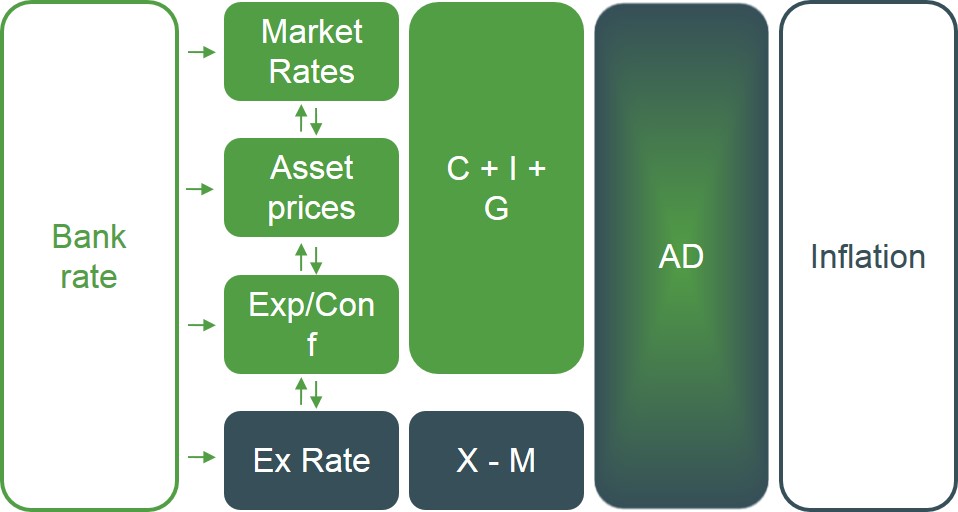
A model that explains the impact of monetary policy on an economy. Below is a simplified version of the transmission mechanism to identify the main channels in which a change in the base rate ultimately affects the economy.

First of all it is important to identify that when the base rate changes this also affects all the other interest rates in the economy - both short and long-run - which will make changes to the availability and ease at which businesses and consumers can acquire credit. For instance if the base rate is cut this should lead to cheaper borrowing from banks to customers. Which in turn fuels higher consumption and investment contributing to higher demand.

This base rate cut will also cause asset prices to surge as asset's become more valuable when deposit interest falls.

A cut in the base rate also causes the exchange rate to depreciate and the domestic currency gets weaker relative to foreign currencies because of hot money flows out of the economy. This makes exports cheaper and imports more expensive, boosting a country's trade position and AD.

All of these effects accumulate and create inflationary pressures in the economy. Higher interest rates will have the opposite effect and will reduce inflationary pressure. Central bank's are able to influence the rate of interest in the economy and use this as the main policy tool for regulating the rate of inflation.

Trend Rate of GDP growth

This is the average growth rate in real GDP over a period of time.

Below is an illustration of the theoretical growth rate for an economy in its economic cycle. This the level of GDP growth that a country should be achieveing if the peak and trough phases of the business cycle have been averaged out.

Between 1948 and 2012 the UK economy has achieved trend growth of 2.6% p.a. compound. The highest annual rate of growth was 7.4% in 1973 and the lowest was -5.2% in 2009.


Trilemma

This represents the difficult choice that all policymakers face when setting domestic policies. That is, many countries would consider it desirable to have a fixed exchange rate, capital mobility and monetary policy autonomy, butis it is only possible to achieve two of these objectives.

The diagram below illustrates the trilemma and the fact that policymakers face a trade-off between these policies and the optimal decision to make would be to sacrfice the least beneficial objective given their particular circumstances. The logic with the diagram is that the policy objective that a country decides to pick the opposite corner of the triangle to that objective mst be sacrificed whilst the two adjacent policies to this objective can be take on.

For instance if a country wanted to pursue a fixed exchange rate i.e. goal 1. Then they would have to sacrifice having a floating exchange rate whilst at the same time having to implement capital controls and losing their own monetary policy autonomy.


Display #